


By Cathy Helin | Elite Sports Performance Coach | Published June 2, 2026
You have trained your athletes hard all off-season. Their conditioning is solid. Their technique is sharp. But when the pressure hits in a big game, they freeze, panic, or fall apart.
Sound familiar?
That moment when physical skill is not enough is where mental toughness for athletes becomes the real game-changer. And as a coach, it is your job to build it.
Research from the American Psychological Association shows that up to 90% of sports performance is mental at the elite level. Yet most coaching programs spend less than 5% of training time on mental skills. That gap is costing your athletes wins, confidence, and long-term growth.
This guide will give you the exact tools, strategies, and exercises you need to build a mentally tough team right now, this season.
Mental toughness is not something you are born with. It is a skill, and like any skill, it can be trained. “, Cathy Helin, Sports Performance Coach
What Is Mental Toughness for Athletes? (And Why Most Coaches Get It Wrong)
Mental toughness for athletes is the ability to perform consistently under pressure, bounce back from failure, and stay focused when it matters most. It is not about being emotionless or never feeling fear.
Most coaches think mental toughness just means being tough , telling athletes to “shake it off” or “push through it.” But that approach often backfires, creating athletes who hide their struggles instead of managing them.
True athletic mental training means teaching athletes specific, repeatable strategies to control their thoughts, emotions, and focus under pressure. It is a structured skill , not a personality trait.
The 4 Pillars of Mental Strength in Sports
- Confidence: Believing in your ability even when results are not going your way
- Focus: Stay present on the next play, not the last mistake
- Composure: Managing emotions under pressure and in high-stakes moments
- Resilience: the ability to recover quickly after setbacks, mistakes, or losses
Why Mental Resilience in Sports Matters More Than Ever This Season
Post-pandemic youth sports have seen a dramatic spike in performance anxiety. A 2024 report by the Sports & Fitness Industry Association found that 35% of youth athletes report high levels of stress during competition, up from 21% in 2019.
Mental resilience in sports is not just a “nice to have” anymore. Here is what low mental toughness costs your program:
- Athletes who quit when competition gets hard
- Talented players underperforming in key games
- Team chemistry breaking down under pressure
- Increased injury risk due to mental fatigue and stress
And here is the flip side: athletes who develop mental strength play harder, recover faster from injuries, and stay in sports longer. A Stanford University study found that mentally resilient athletes are 2.5x more likely to perform at their peak during championships.
Dealing With Pressure in Sports: What Your Athletes Are Really Feeling
Before you can coach it, you need to understand it. When athletes face high-pressure moments, their brains trigger the stress response, heart rate spikes, muscles tighten, and focus narrows.
Dealing with pressure in sports effectively starts with normalizing this experience. Let your athletes know: pressure is not weakness. It is your body preparing to perform.
Here are the most common signs an athlete is struggling mentally:
- Rushing plays or decisions under pressure
- Overthinking technique at critical moments
- Consistent underperformance in games vs. practice
- Excessive fear of making mistakes
- Withdrawal from leadership moments on the field
If you see these signs, do not wait. Addressing mental performance early is far more effective than trying to fix it mid-season or after a crisis.
Read about “How trauma affects young athletes: A Conversation with Dr. Don Wood.”
How to Build Mental Toughness for Athletes: Proven Training Methods
Building mental toughness for athletes requires consistency, repetition, and intentional practice, just like physical skills. Here is what works.
1. Pre-Performance Routines
One of the most evidence-backed methods in sports psychology for athletes is the pre-performance routine. This gives athletes a mental “anchor” before competition , a specific set of actions and thoughts that signal readiness.
- Choose 3-5 consistent actions done before every game or big play
- Include a physical component (deep breath, stretch, clap), a focus cue (one word or phrase), and a visualization step
- Practice it in training until it becomes automatic under pressure
2. Mental Toughness Exercises for Athletes
Incorporate these mental toughness exercises for athletes directly into your practice sessions:
- Adversity drills: Simulate pressure situations (e.g., start the scrimmage already down 3 points)
- Controlled breathing practice: Teach box breathing: 4 counts in, hold 4, out 4, hold 4
- Mistake rituals: Have athletes physically “reset” after errors (e.g., fist pump and take one deep breath)
- Pressure scrimmages: Increase stakes incrementally so athletes become comfortable with discomfort
- Journaling: 5-minute post-practice reflection to track mental patterns over time
3. How to Train Your Mind for Sports Performance
Knowing how to train your mind for sports performance is about daily mental reps, not just pre-game speeches. Build these habits into your weekly schedule:
- Monday: Team visualization session (5 minutes), “See” the upcoming game going well
- Wednesday: Self-talk workshop. Identify negative thought patterns and replace them
- Friday: Pressure drill day, Compete in high-stakes scenarios with consequences
- Post-game: Debrief focused on mental performance, not just physical results
How to Bounce Back After a Bad Game: A Coach’s Playbook
Knowing how to bounce back after a bad game is one of the most valuable skills you can teach. The 24-Hour Rule is the gold standard:
The 24-Hour Rule: Athletes get 24 hours to feel the loss, frustration, or disappointment fully. After 24 hours, they commit to forward focus only.
As a coach, your response to a bad game matters enormously. Research shows athletes mirror their coach’s emotional state within minutes of a loss. Stay composed, focus on process over outcome, and lead the team through it with structure.
- Hold a brief post-game debrief: limit it to 10 minutes and focus on 1 thing to fix
- Acknowledge the result without dwelling: “We did not get the outcome we wanted.” Here is what we do next.”
- Give athletes space to process, then re-engage with energy at the next practice
How to Stop Being Mentally Weak in Sports: The Athlete’s Mindset Reset
One of the most common questions athletes and parents search for is how to stop being mentally weak in sports. It is the wrong question, but it points to a real struggle.
No athlete is “mentally weak.” They are mentally untrained. And that is fixable.
Here is how to reset an athlete’s mindset in 3 steps:
Step 1: Identify the limiting belief, “I always choke under pressure” or “I am not good enough.”
Step 2: Challenge it with evidence. Ask, “Has there been a time you performed well under pressure?” “What was different?”
Step 3: Replace it with a process cue, “I prepare, I breathe, I execute.”
This technique comes directly from cognitive behavioral sport psychology, a method used by Olympic coaches and elite performance programs worldwide.
For deeper reading, we recommend the Association for Applied Sport Psychology (AASP) , the leading credentialing body for certified mental performance consultants.
Why Coaches Trust Cathy Helin for Mental Performance Training
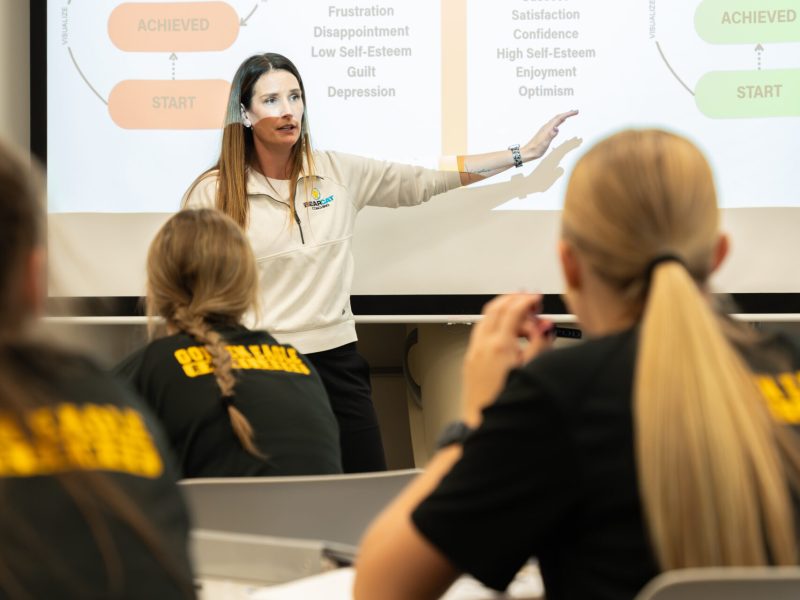
Cathy Helin is an elite sports performance coach with over a decade of experience working with youth, collegiate, and professional athletes. Her work sits at the intersection of sports psychology, peak performance coaching, and athlete development.
Her athletes have competed at Division I programs, national championships, and professional leagues. Cathy’s approach is rooted in evidence-based sports psychology principles, adapted for real-world coaching environments, not just theory.
- Certified sports performance coach with advanced mental skills training
- Worked with athletes across multiple sports, including soccer, basketball, swimming, and track
- Creator of the Mental Edge Athlete Program , a structured 8-week mental training curriculum for coaches and athletes
- Featured speaker at regional and national coaching development conferences
Every athlete has physical potential. “My job is to make sure mental limits never hold them back.” , Cathy Helin
To Sum Up: What Every Coach Needs to Know About Mental Toughness for Athletes
Mental toughness for athletes is not optional anymore; it is a competitive advantage. The coaches who invest in mental skills training build teams that are harder to beat, easier to coach, and more resilient through a full season. Here is your quick-start checklist:
- Add 5-10 minutes of mental skills work to every practice
- Teach and use pre-performance routines consistently
- Practice the 24-Hour Rule after every loss
- Use adversity drills to build pressure tolerance
Model composure and resilience as a coach; your athletes are watching you. You do not have to figure this out alone. Cathy Helin’s coaching programs are built specifically to help coaches like you build mentally tough athletes from the ground up.
Ready to Build a Mentally Tough Team? Work with Cathy Helin this season. Visit Bearcat Coaching to schedule a free discovery call and learn how the Mental Edge Athlete Program can transform your team’s performance.
Frequently Asked Questions
1. What does mental toughness for athletes actually mean?
Mental toughness for athletes means the ability to stay focused, confident, and composed under competitive pressure. It includes handling adversity, recovering from mistakes quickly, and maintaining consistent performance when the stakes are high.
2. At what age should athletes start mental skills training?
Athletes can start basic mental skills training as early as age 8-10, starting with simple breathing techniques and positive self-talk. More structured athletic mental training programs are typically introduced at ages 12 and up, when athletes have greater self-awareness.
3. How long does it take to build mental resilience in sports?
Most athletes begin to see measurable improvements within 6-8 weeks of consistent mental skills practice. Full mental resilience in sports develops over a full season or longer , similar to how physical strength develops through regular training.
4. How can coaches help athletes deal with pressure in sports without therapy?
Coaches play a massive role in dealing with pressure in sports through structure, routine, and communication. Pre-performance routines, adversity drills, post-game debriefs, and consistent emotional modeling from coaches are all proven non-clinical tools that make a significant impact.
5. Do I need a sports psychologist, or can a performance coach help?
Sports psychologists are licensed clinicians who address clinical mental health concerns. A sports performance coach like Cathy Helin focuses on mental skills training for healthy athletes who want to optimize performance. For most teams, a qualified sports performance coach is the right fit to build mental toughness and a winning mindset.